
Reviewed · TICKETS
Maui Ocean Center All Day Admission Ticket
The best reason to visit Maui Ocean Center is the Humpback Whales of Hawaiʻi 3D Sphere, a short film-style experience that places you beneath the surface with humpback whales. It is not a real whale encounter, of course, but it gives you a striking sense of their size and movement without leaving Maalaea.
I like the focus on animals native to Hawaiian waters, rather than a general collection of creatures from around the world. I also like the mix of quiet exhibits, touch pools, cultural demonstrations, and scheduled talks, which gives children and adults different ways to stay interested.
The main consideration is size. At $55.44 per person, this is not a giant aquarium on the scale of Monterey Bay or a major city aquarium. Some people will see everything in about an hour, while those who read the displays and attend talks can easily stay four hours or more.
Key points to know before you go
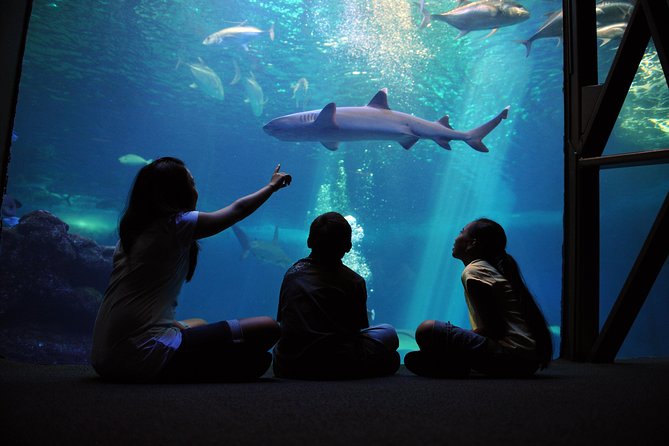
- The 750,000-gallon Open Ocean exhibit gives you the aquarium’s biggest underwater view, with sharks, rays, and other Pacific species moving overhead and around you.
- The 3D whale sphere is the signature attraction, but the presentation is brief and children under five cannot participate.
- More than 60 exhibits focus on Hawaiian waters, including live Pacific coral, sea jellies, octopuses, eels, turtles, and reef fish.
- Daily presentations add structure, with talks at Turtle Lagoon, Shark Nursery Bay, Open Ocean, Discovery Pool, Living Reef, and Nursery Bay.
- You can return throughout the day, entering between 9 a.m. and 5 p.m. with final entry at 4 p.m.
- Seascape Restaurant and Maui Ocean Treasures make it possible to add a meal or shopping stop without leaving the center.
What Maui Ocean Center does best
Maui Ocean Center works because it gives you a close look at the marine life surrounding the Hawaiian Islands. The displays are not simply a parade of colorful fish. They explain the role of coral, the importance of local species, and the need to protect ocean habitats.
That local focus matters. You are seeing fish and marine animals connected to the waters around Maui, not a random world aquarium collection. The setting also gives the aquarium a useful purpose: it can help you understand what lies below the surface when you snorkel, swim, or watch for whales from shore.
The center is clean, easy to walk through, and suitable for mixed-age families. A two-year-old can enjoy the movement of fish and sharks, while an adult can spend time reading about coral restoration and Hawaiian marine life. Several areas also offer good photo opportunities, especially the larger tanks and the clear tunnel.
I would set aside about two hours for a straightforward visit. If you attend several presentations, stop for lunch, and read the signs, plan on three to five hours. The all-day ticket lets you pace yourself instead of rushing from exhibit to exhibit.
A few more Maui mornings worth comparing
- Road to Hana: Full-Day Scenic Drive with Blacksand & Waterfalls
★ 4.5 · 837 reviews - Oahu Ultimate Circle Island Tour Full Day Experience
★ 4.5 · 762 reviews - Full Day Oahu Circle Island -Turtle Beach Snorkel at North Shore
★ 5.0 · 662 reviews
Starting with the Living Reef and Pacific coral
The Living Reef exhibits are a good place to begin. They show coral and reef fish in a setting that helps you see the relationship between the animals and their habitat. The live Pacific coral display is one of the center’s most important features, especially if you have only seen coral while snorkeling and want a closer, calmer look.
The smaller tanks can be more rewarding than the large ones because you can spot unusual animals. Frogfish, eels, reef fish, and small creatures are easier to study when you are not standing several feet away from a massive tank.
A daily presentation at the Living Reef adds context. Exact presentation times can vary by area, so check the schedule when you enter. The naturalists are available around the exhibits to answer questions about fish, plants, and coral.
This part of the aquarium rewards patience. If you rush through, you may see a wall of fish and move on. If you slow down, you might notice camouflage, unusual body shapes, or animals hiding among the coral.
The 750,000-gallon Open Ocean exhibit
The Open Ocean exhibit is the center’s major tank, holding 750,000 gallons of water. It is where you get the broadest sense of the aquarium’s scale, with sharks, stingrays, and other Pacific creatures moving through a large underwater environment.
The clear tunnel is a particularly good stop for photographs. A manta ray may pass overhead, while sharks and rays move beneath or beside you. There is also a glass floor area where you can look down as sharks swim below. That feature gives the visit a little theater without turning the whole aquarium into a noisy attraction.
A presentation at Open Ocean helps you make sense of what you are seeing. Without some explanation, large tanks can blur into a series of animals passing by. With a naturalist’s talk, you can pay attention to behavior, body shape, and the role each animal plays in the ocean.
The tank is also one of the best places to pause with young children. A toddler may not read a display, but moving sharks and rays hold attention. Keep a hand on small children in crowded areas, particularly near open walkways and the nearby playground.
Turtles, sharks, and the smaller encounters
Turtle Lagoon offers a gentler, slower stop. The daily Marine Naturalist Presentations take place at 10:30 a.m. and 2:30 p.m. If turtles are a priority for you, plan your route around one of those times.
Shark Nursery Bay is another scheduled highlight, with presentations at 11:45 a.m. and 1:45 p.m. This area helps you look at sharks as living animals rather than movie villains. The smaller setting may be more informative than simply seeing a shark glide past in a large tank.
At Tide Pool Tactile Discovery, you can use two fingers to touch selected marine animals. This is controlled contact, not a free-for-all. Follow the staff instructions and treat the animals gently. The touch pool is especially useful for children because it turns a display into a direct, supervised encounter.
You can also see sea jellies, octopuses, eels, tropical reef fish, stingrays, and other animals. The mix is broad enough to keep a family moving, though the center is not enormous. One visitor group with four children finished in less than an hour, even after spending extra time watching sharks.
Same island, a completely different kind of day:
- Maui Pineapple Farm Tour in Haliimaile
★ 5.0 · 2,855 reviews - Maui Eco-Raft Tour: Eye-Level Whale or Dolphin Watching – Lahaina
★ 5.0 · 2,482 reviews - Maui Snorkeling Adventure to Molokini and Turtle Town
★ 4.5 · 2,221 reviews - Maui: Haleakala Sunrise Spectacular with Local Breakfast
★ 4.5 · 2,155 reviews
Why the 3D humpback whale sphere matters
The Humpback Whales of Hawaiʻi 3D Sphere is the most talked-about feature for good reason. The round screen surrounds you with underwater footage, creating the feeling of being close to humpback whales. It is a virtual experience, but the scale and movement make it more memorable than a standard flat-screen film.
The presentation is short. Think of it as a strong feature within the aquarium, not a full-length show that occupies a large part of your day. If you are visiting mainly for the whale sphere, the admission may feel expensive.
Children under five are not permitted to take part in the sphere experience. Families with very young children should plan around that limitation. The rest of the aquarium remains available to them, including the fish exhibits and tactile pool.
The sphere also connects naturally with Maui’s wider ocean story. The center’s conservation message is not limited to whales. It links marine animals, coral, and human responsibility, giving the exhibit more purpose than a simple visual effect.
Cultural activities and daily presentations
The aquarium includes cultural activities along with marine exhibits. A wood carving demonstration offers a change of pace and gives you a look at a Hawaiian tradition connected to craft and local identity.
The daily naturalist presentations are worth planning around if you want more than a self-guided walk. Talks take place at Turtle Lagoon, Shark Nursery Bay, Open Ocean, Discovery Pool, Living Reef, and Nursery Bay. The listed times for Turtle Lagoon and Shark Nursery Bay are especially useful when building a route through the center.
You do not need to attend every talk. Choose two or three that match your interests, then explore the nearby exhibits before or after. This approach keeps the visit from feeling like a timed school field trip.
The staff also remain available around the exhibits. Ask about a fish you cannot identify or a coral feature you do not understand. These short conversations can add more value than reading every sign in order.
Lunch, shopping, and the full-day option
The ticket allows entry from 9 a.m. until 5 p.m., with final entry at 4 p.m. That makes it possible to arrive early, leave for another Maalaea activity, and return later, though you should confirm the re-entry procedure when you arrive.
You can eat at Seascape Restaurant, an Ocean-Friendly certified restaurant with fresh catch specials and island-inspired dishes. A meal here can make the center a half-day stop instead of a quick indoor break. Food and drinks are not included in the ticket, so budget separately.
Maui Ocean Treasures gift shop offers souvenirs and ocean-themed items. The shop is useful if you want a final look at conservation and marine-life material, but it also adds another expense if you are watching your budget.
Paid parking costs $3 per hour and is handled through the ParkLinq app or a QR code on arrival. Add this to the admission price when comparing the center with other Maui activities.
Is $55.44 a fair price?
At $55.44 per person, the ticket is reasonable for a visitor who stays several hours, attends presentations, uses the all-day access, and values the whale sphere. It is harder to justify if you expect a huge aquarium or plan to walk through in 60 minutes.
The value improves for families who need a break from sun, wind, or uncertain weather. It is also a practical choice for children who may not manage a long snorkel trip. The touch pool, turtles, sharks, and large tanks offer several age-friendly stops without requiring strong swimming skills.
The price feels less attractive if you have recently visited a much larger aquarium. The center is medium-sized, and some displays are more modest than the admission cost might suggest. A few areas rely on photographs or interpretive material, so not every stop offers a large live exhibit.
I would book it for a marine-life enthusiast, a family with young children, or anyone who wants a thoughtful indoor activity in Maui. I would hesitate if you have only one free hour or mainly want a whale encounter. In that case, the whale sphere alone is unlikely to provide enough value.
Practical details for a smoother visit
The meeting point is Maui Ocean Center at 192 Maalaea Road in Wailuku. The scheduled start is 9 a.m., but admission is available throughout the day during operating hours. You can reach the area by public transportation, and service animals are allowed.
Most of the center is accessible and easy to walk around. However, some presentation areas are in stairwells, and the rocky surroundings can be difficult for anyone with mobility problems. If you use a wheelchair or have trouble with stairs, ask staff which presentation locations are easiest to reach before choosing your schedule.
Bring your phone for the mobile ticket. Check the presentation schedule soon after entering, then decide which talks fit your pace. If you want a quieter visit, going early may help, though crowd levels can change.
The cancellation rule is simple but strict: cancel at least 24 hours before the start time for a full refund. Cancellations or changes made within 24 hours are not refunded or accepted. Car trouble or a late change can therefore turn this into an expensive missed activity.
Who should book Maui Ocean Center?
I would recommend it most strongly to families, ocean lovers, and people who want to learn about Hawaii’s marine life without booking a boat trip. The center is clean, well maintained, and flexible enough for a quick visit or a longer half-day outing.
It is also a good rainy-day or midday option, although not every exhibit is indoors. The restaurant and gift shop make the stop easy to stretch, and the talks provide useful structure.
You should think twice if you compare every aquarium with the largest facilities on the mainland. Maui Ocean Center is not trying to compete on sheer size. Its value comes from its Hawaiian focus, the live coral, the accessible displays, the Open Ocean tank, and the whale sphere.
Should you book it?
Book Maui Ocean Center if you want a local, educational look at Hawaiian waters and can spend at least two hours there. Arrive with enough time for the whale sphere, one turtle talk, one shark presentation, and the Open Ocean exhibit.
Skip it if your schedule is tight or you expect a massive aquarium for the price. For the right visitor, especially a family with children or someone who loves marine life, it is a worthwhile Maui stop. Just judge the ticket as a medium-sized local aquarium with several excellent features, not as an all-day mega-attraction.
FAQ
How long should I plan to spend at Maui Ocean Center?
The average visit takes about two hours, but you can stay longer by attending presentations, reading the displays, eating at Seascape Restaurant, and revisiting exhibits. Some people finish in about an hour, while others spend four to five hours.
What time can I enter Maui Ocean Center?
All-day access is available from 9 a.m. to 5 p.m. The last chance to enter is 4 p.m.
Is the Humpback Whales of Hawaiʻi 3D Sphere included?
Yes. The Humpback Whales of Hawaiʻi 3D Sphere is included with admission. Children under five are not permitted to participate.
What animals can I see?
The aquarium includes sharks, stingrays, turtles, eels, octopuses, sea jellies, tropical reef fish, live Pacific corals, and other marine life native to Hawaiian waters.
Are there daily presentations?
Yes. Marine naturalist presentations take place at several exhibits. Turtle Lagoon presentations are at 10:30 a.m. and 2:30 p.m. Shark Nursery Bay presentations are at 11:45 a.m. and 1:45 p.m.
Can I touch any marine animals?
Yes. Tide Pool Tactile Discovery allows supervised two-finger touch with selected marine animals.
Is parking included?
No. Parking costs $3 per hour and is paid through the ParkLinq app or a QR code upon arrival.
Can I cancel for a refund?
You can cancel at least 24 hours before the experience start time for a full refund. Cancellations or changes made less than 24 hours before the start time are not accepted and are not refunded.
Just added around Maui
- Maui: Waterfalls of West Maui and Molokai Helicopter Tour★ 4.9 · 6 reviews
- Ka’anapali: Whale Watching Boat Tour★ 5.0 · 14 reviews
- Kaanapali: Sunset Dinner Catamaran Cruise With Drinks★ 4.8 · 55 reviews
- Kahului: Doors-off West Maui and Molokai Helicopter Tour★ 4.9 · 33 reviews
- Ka’anapali Beach: Coral Reef Snorkel and Turtle Spotting★ 4.9 · 135 reviews
- Hali’imaile: Pineapple Farm Tour★ 4.9 · 126 reviews
- Hana Rainforest and Haleakala Crater 45-min Helicopter Tour★ 5.0 · 18 reviews
- From Maalaea: Whale Watching Catamaran Cruise with Drinks★ 4.7 · 26 reviews
Tickets, compared.

Waikiki Luau Buffet with Optional Rock-A-Hula Show Ticket
Read our review →
Princeville Botanical Gardens Tour and Chocolate Tasting Ticket
Read our review →


Polynesian Cultural Center: Islands of Polynesia Admission Ticket
Read our review →
Diamond Head Hike Shuttle with Reservation Tickets Included
Read our review →
Polynesian Cultural Center Island Villages Ticket
Read our review →
Browse the lists this tour appears in