
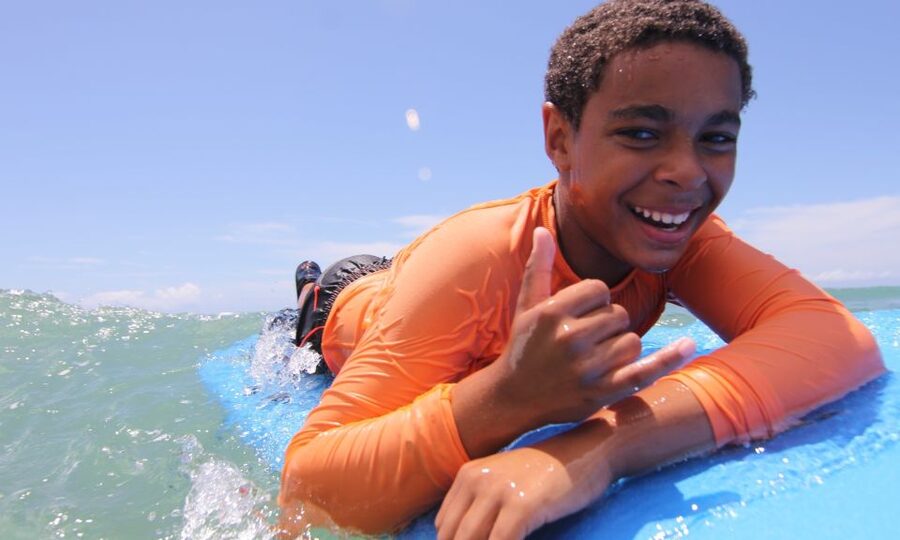
Reviewed · SURF LESSONS
Oahu: Waikiki 2-Hour Semi-Private Surfing Lesson
The best part of this Waikiki surf lesson is the quieter beach setting. You get room to learn without the full commotion of a packed resort beach, then put the basics to work in the water with an instructor from Kai Sallas’ Pro Surf School Hawaii. I like the useful 20-minute land session and the fact that equipment is supplied, including reef protection and booties. The main drawback is that instruction is in English, even though one booking was made with the expectation of Spanish instruction.
I also like the small-group format, described as a private group, because early surfing lessons go better when the instructor can watch your timing and body position. At $156 per person for two hours, this is not a bargain beach rental. It makes the most sense if you want actual coaching, not just a board and a quick explanation.
Key points for choosing this surf lesson
- A 20-minute land lesson comes first: Learn about waves, currents, wind, tides, safety, etiquette, and standing position before entering the water.
- The beach is near Waikiki but more secluded: You get a calmer setting for your first attempts.
- Instruction covers more than standing up: You’ll work on paddling, turning, board control, and handling breaking waves.
- Equipment is included: A surfboard, leash, rash guard, reef protection, and booties are provided.
- The lesson suits several skill levels: Complete beginners can learn the basics, while advanced surfers can ask about local conditions.
- English is the stated language: Confirm language needs before booking, especially if you need instruction in Spanish.
Why a quieter beach matters for your first waves
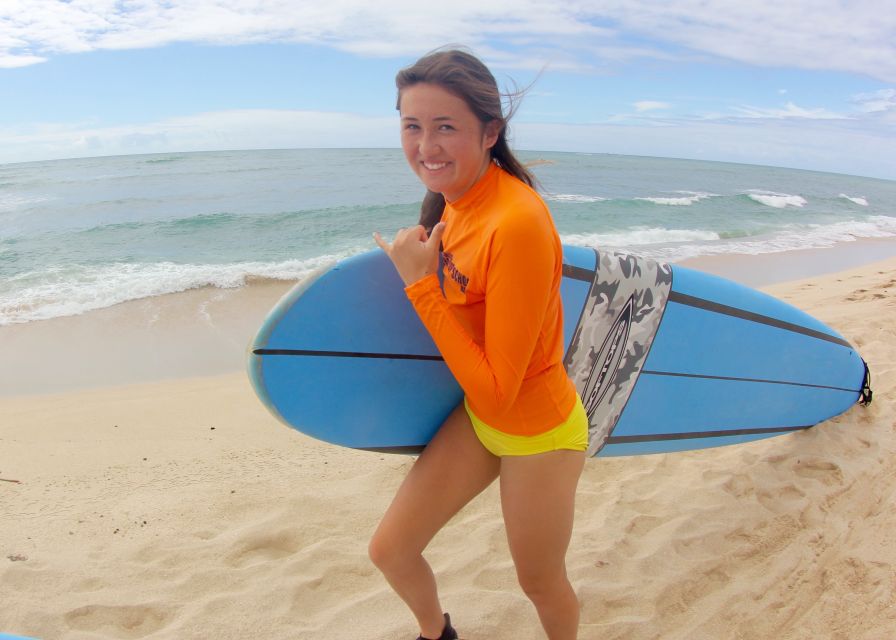
Waikiki is famous for beginner-friendly surfing, but a busy beach can make a first lesson feel rushed. This experience takes place at a secluded beach near Waikiki, giving you a less hectic place to focus on the board, the instructor, and the next wave.
That setting matters most when you are still learning what to watch. At first, the ocean gives you a lot to process: wave direction, timing, balance, paddling, and the movement of other surfers. A quieter spot can help you pay attention to the instructions instead of worrying about every person around you.
The beach is not described as completely private, so do not expect an empty stretch of sand reserved only for your group. The useful distinction is that it is presented as more secluded than the main Waikiki surf areas. For a new surfer, that can be worth paying for.
You should also keep your expectations sensible. Two hours is enough to learn the basic movements and catch some waves, but it is not enough to turn you into an independent surfer. Your goal is to understand safe positioning, get comfortable on the board, and make a few controlled attempts.
More Surf Lessons in Oahu
- Open Group Surfing Lesson in Waikiki, Hawaii
★ 4.5 · 582 reviews - Oahu: Beginner-Friendly Waikiki Beach Surfing Lesson
★ 4.9 · 425 reviews - Surfing Lessons On Waikiki Beach
★ 4.5 · 317 reviews
The 20-minute land lesson builds the foundation
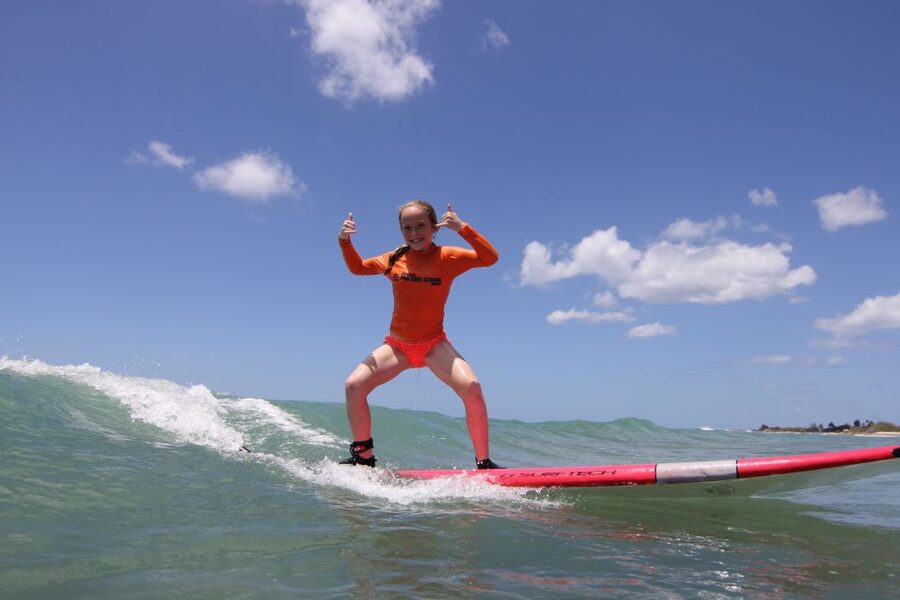
The lesson begins on land with about 20 minutes of preparation. This is not filler. For a beginner, it may be the most important part of the session because it explains what the water is doing before you have to react to it.
Your instructor covers waves, currents, winds, and tides. These topics help you see the beach as more than a place where waves roll toward shore. You need to know how water moves and how conditions affect your position before you start paddling.
You’ll also learn proper positioning for standing up. That movement is often where new surfers struggle. The board must be stable, your hands and feet need to work in the right order, and you need to rise without throwing off your balance. A short lesson on land lets you practice the sequence before trying it on a moving board.
Surf etiquette is part of the briefing as well. That includes the basic rules for sharing waves and behaving safely around other surfers. This is useful even if you plan to surf only once, since good etiquette keeps the lesson safer for everyone in the water.
Water safety gets equal attention. You’ll be briefed on how to use the board, leash, and fins, then learn how to handle the equipment before heading out. I appreciate that the lesson explains the gear rather than simply handing it over. A leash is not decoration, and knowing how your board responds makes the water session less confusing.
Choosing the board and protective gear
The school lets you select equipment based on your skill level. That is a practical touch because the board you need as a complete beginner is not necessarily the board an advanced surfer wants for local conditions.
The equipment package includes a surfboard and leash, along with a rash guard, reef protection, and booties. You still need to bring a towel and sunscreen. The supplied rash guard can help protect your skin while you paddle, and the reef protection and booties are useful around a beach where contact with the bottom may be a concern.
The listing does not specify the exact board types, sizes, or brands, so you should not arrive expecting a particular model. The important point is that the instructor helps match the equipment to your ability rather than asking you to manage the choice alone.
If you are a complete beginner, listen closely when the board is explained. Learn where to lie, how far forward to position yourself, and how to hold the board while moving through the water. Small errors on land become tiring mistakes once you are paddling.
Moving from paddling to standing up
After the land briefing, you enter the water and learn how to move through the waves. The progression is sensible: first understand the board, then paddle, then work on turning and maneuvering, and finally try to stand and ride.
Paddling is more important than it may look. You need enough speed to match a wave, but you also need to keep the board pointed in the right direction. Your instructor can watch your timing and show you how to use your arms without wasting energy.
Getting through the breaking waves is another part of the lesson. The instructions cover how to maneuver over crashing waves, which is especially useful for a first session. This is where the earlier briefing on conditions becomes practical. You are not simply waiting for a wave to arrive. You are learning how to move the board into position and stay in control.
Turning and maneuvering come next. These skills help you steer instead of riding in a straight line by accident. At the beginner level, the aim is not stylish footwork. It is learning how your weight affects the board and how to make basic changes without losing balance.
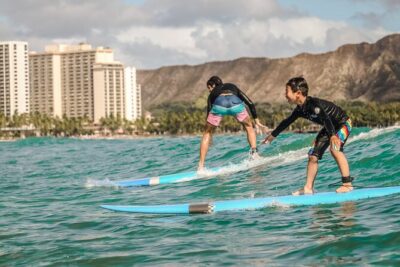
Then comes the part everyone is waiting for: standing and riding. Your instructor works with you on the proper movement and timing. Some people stand quickly; others need several attempts. The lesson is designed for both possibilities, with professional instruction aimed at helping you make the right adjustments.
Same island, a completely different kind of day:
- Oahu Grand Circle Island and Haleiwa Tour: 9-Hr Deluxe Experience
★ 5.0 · 17,387 reviews - Oahu: Grand Tour Around Island 16 Locations plus Snorkeling
★ 5.0 · 8,669 reviews - Parasailing Experience in Waikiki, HI
★ 5.0 · 7,692 reviews - Salute to Pearl Harbor Including USS Arizona
★ 4.5 · 7,433 reviews
What the two-hour schedule really gives you
The total session lasts two hours, including the land briefing. That leaves roughly an hour and 40 minutes for gearing up, entering the water, instruction, practice, and returning equipment, although the exact timing can vary.
That is a useful length for a first lesson. A shorter session might leave you just as you begin to understand the board. A much longer lesson could become tiring, especially when you are paddling and repeatedly trying to stand.
You should pace yourself. Surfing uses your arms, shoulders, legs, and core, and new surfers often spend more energy than they expect. Pay attention to the instructor’s advice about when to rest and how to conserve effort.
Advanced surfers can also use the lesson differently. Instead of starting with the full beginner sequence, you can focus on local conditions, wave behavior, and maneuvering. The activity is open to advanced surfers who want to learn the area, though the supplied information does not promise a specialized advanced curriculum. If you are experienced, explain your goals at the start.
The private-group format and personal attention
The activity is described as a private group, while the title calls it semi-private. Since the exact number of participants is not provided, I would confirm the group size before paying if personal attention is your main reason for booking.
Still, the format is aimed at focused instruction rather than a large class. That matters because surfing is learned through quick corrections. An instructor needs to see whether you are lying too far forward, paddling too late, standing too slowly, or turning your shoulders in the wrong direction.
One especially useful piece of feedback from the supplied comments is that the instructor gave many helpful tips and paid close attention. That matches what you should want from a lesson. A friendly instructor is nice, but clear corrections are what help you improve.
The school is Kai Sallas’ Pro Surf School Hawaii. No individual instructor name is supplied, so do not assume you will have a particular teacher. The experience is conducted in English, and one Spanish-language booking received English instruction instead. If language matters to you, contact the provider before booking and confirm what can actually be offered.
Is $156 a fair price?
At $156 per person, this lesson costs more than simply renting a surfboard for two hours. That comparison is fair, but it misses the point. You are paying for instruction, equipment, a safety briefing, and a quieter teaching location.
The price is easier to justify if you are a first-time surfer. Renting a board without knowing how to read waves or handle the equipment can produce a frustrating and unsafe session. An instructor helps you get useful practice from the limited time you have in Hawaii.
The value is also better if you want a private or semi-private setting. A large class may cost less per person, but you may spend more time waiting or repeating the same mistake. Here, the supplied gear and targeted instruction reduce the number of things you need to arrange yourself.
For an advanced surfer, the value depends on how much local guidance you need. If you already know how to surf and only want a board, $156 is likely too much. If you want help understanding local conditions and refining your technique, the price may make sense.
Free cancellation up to 24 hours before the activity and the option to reserve now and pay later add useful flexibility. Those terms help if your Hawaii schedule is still shifting, but check the booking conditions at the time you reserve.
Who should book, and who should skip it
This lesson is best for adults and older children who want a structured introduction to surfing near Waikiki. It suits beginners who value instruction, travelers who want equipment included, and experienced surfers who want help with local conditions.
Children age 10 and under, or anyone who is a weak swimmer, must take a private one-on-one lesson for safety reasons. That is an important rule, not a minor detail. If this applies to someone in your group, ask about the private format before booking.
The activity is not suitable for pregnant women, people with back problems, or people with mobility impairments. Surfing requires paddling, lifting yourself onto the board, balancing, and handling moving water, so these restrictions should be taken seriously.
You should also be comfortable with basic water activity. The lesson includes safety instruction, but it is not presented as a swimming course. Bring sunscreen and a towel, and expect to spend the session working physically rather than simply floating near shore.
Practical details to know before you reserve
The stated language is English. The activity lasts two hours, and available start times should be checked for your chosen date.
The package includes the surfboard, leash, rash guard, reef protection, and booties. Bring your own towel and sunscreen. No transportation details are provided, so do not assume hotel pickup or a shuttle from Waikiki.
The experience has a 4.9 rating from five bookings, with the strongest praise focused on the instructor, the secluded beach, and the helpful coaching. One booking received four stars because Spanish instruction was expected but English was provided. That makes the language point worth confirming rather than overlooking.
Should you book this Waikiki surf lesson?
Book it if you want more than a quick board rental and like the idea of learning at a quieter beach with a focused instructor. The 20-minute land session, included protective gear, and progression from paddling to standing make the lesson a sensible first step into surfing.
I would be more cautious if you are only looking for a cheap activity, need instruction in Spanish, or have health or mobility concerns listed in the restrictions. For everyone else, $156 is a reasonable spend when you value coaching, safety, and a better chance of actually catching a wave during your two hours.
FAQ
How long is the surfing lesson?
The lesson lasts two hours, including the land briefing and water instruction.
Where does the lesson take place?
It takes place at a secluded beach near Waikiki in Hawaii.
What happens during the land portion?
You learn about waves, currents, winds, tides, standing position, surf etiquette, and water safety. You also receive a briefing on using the board, leash, and fins.
Is equipment included?
Yes. The activity includes a surfboard, leash, rash guard, reef protection, and booties.
What should I bring?
Bring a towel and sunscreen.
Is the lesson offered in Spanish?
English is the stated language. One booking made with the expectation of Spanish instruction received the lesson in English, so confirm language availability before booking.
Can children or weak swimmers join?
Children age 10 and under, as well as weak swimmers, are required to take a private one-on-one lesson for safety reasons.
More 2-Hour Experiences in Oahu
- 2-Hour Oahu Whale Watch from Ala Wai Harbor, Waikiki
★ 4.5 · 1,929 reviews - Waikiki, Oahu 2-Hour Whale Watching: Guaranteed Sightings
★ 4.5 · 1,064 reviews - Kailua 2-Hour Guided Kayaking Excursion, Oahu
★ 5.0 · 442 reviews - Oahu: Waikiki 2-Hour Beginner Group Surf Lesson
★ 4.9 · 191 reviews
Just added around Oahu
- Kailua: Mokulua Islands Guided Kayak and Snorkeling Tour★ 4.9 · 46 reviews
- Oahu: Sips & Secrets of Hawaii Pub Crawl★ 5.0 · 19 reviews
- Honolulu, Oahu: Waikiki Whale Watching Cruise★ 3.5 · 166 reviews
- Oahu: Honolulu Turtle Canyon Snorkeling Tour★ 4.6 · 136 reviews
- Oahu: USS Arizona Memorial and City Highlights Tour★ 4.2 · 32 reviews
- Honolulu: Waikiki Food Tour with Local Guide★ 5.0 · 3 reviews
- Oahu: Traditional Canoe Sunset Cruise with Dinner★ 5.0 · 4 reviews
- Oahu: Hilton Waikiki Beach Hotel Magical Mystery Show★ 4.7 · 39 reviews
Surf Lessons, compared.

Beginner-Friendly Waikiki Beach Surfing Lesson
Read our review →
Private Hanalei Sandy Bottom Surf Lesson on Kauai
Read our review →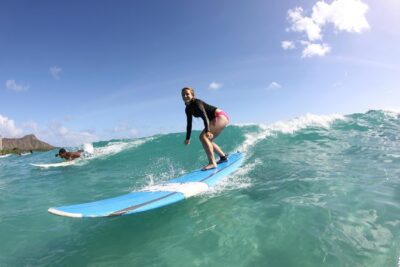
Browse the lists this tour appears in